

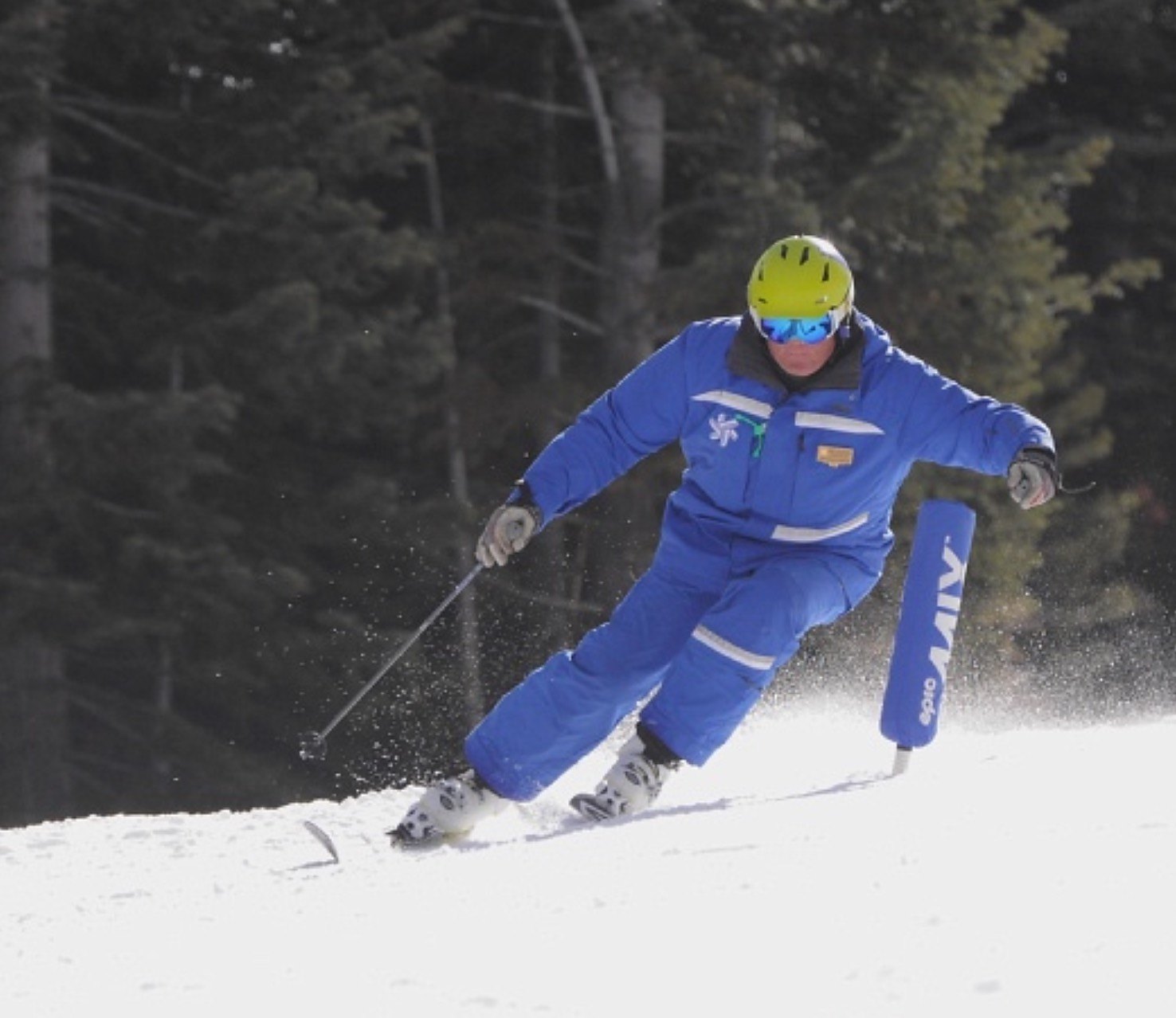
Almost every skier who tells me they have plateaued is trying to fix the wrong layer. They want to be faster, or smoother, or to finally handle the steep run their friends disappear down. So they work on the thing they can see. The problem is nearly always sitting underneath it, out of sight, which is why I draw them an iceberg.
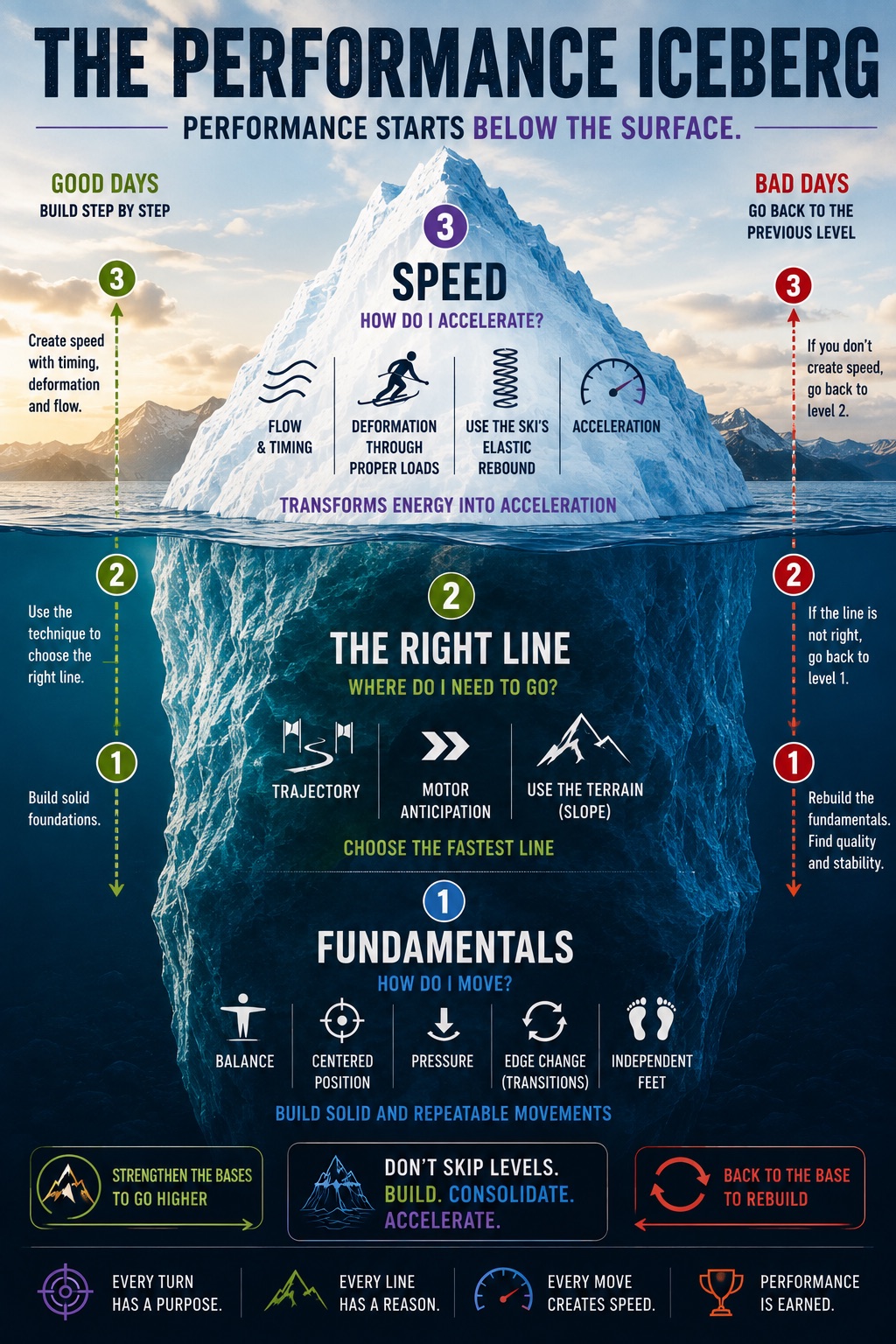
Speed
How do I accelerate?
- Flow & timing
- Deformation through proper loads
- Using the ski’s elastic rebound
- Acceleration
Transforms energy into acceleration
The Right Line
Where do I need to go?
- Trajectory
- Motor anticipation
- Using the terrain
Choose the fastest line
Fundamentals
How do I move?
- Balance
- Centered position
- Pressure
- Edge change and transitions
- Independent feet
Build solid and repeatable movements
The part everyone can see is the part that matters least
Speed is the tip. It is what shows up on video, what your friends comment on, and what you feel when a run goes well. It is also the thinnest layer, and it is entirely held up by everything underneath.
When somebody asks me to make them faster, what they are usually asking is for me to work on tier three. And I can, for about ten minutes, before whatever is broken at tier one reappears. You cannot build acceleration on a platform that moves.
Level 1: Fundamentals. How do I move?
Balance, a centered position, pressure management, edge change, independent feet. These are not beginner topics. I still work on them, and so does every examiner I know.
What makes them fundamental is that they are the movements everything else is assembled from. If your pressure arrives late, no line choice will save the turn. If your feet are not independent, terrain will pick the line for you rather than the other way round.
The test is not whether you can do them. It is whether you can do them repeatably, when tired, on terrain you did not choose, without thinking about it.
Level 2: The right line. Where do I need to go?
Once the movements are dependable, you get to make decisions with them. Trajectory, anticipation, reading what the slope is offering.
This is the layer most keen intermediates never realize exists. They have decent technique and they are still working much harder than the skier next to them, because that skier is using the terrain and they are fighting it. Same fitness, same skis, completely different day.
Line is also the first layer where the mountain becomes a conversation rather than an obstacle. It is why a coached day on real terrain does something a lesson on a groomer cannot.
Level 3: Speed. How do I accelerate?
Now we can talk about what most people wanted to talk about at the start. Flow and timing. Loading the ski so it deforms properly. Using the rebound instead of absorbing it. Turning energy into acceleration rather than into noise and spray.
This layer is genuinely fun to coach, and it is the one that makes a skier look different from the chairlift. It is also the layer that collapses first and fastest when anything below it is shaky.
Why the order is not a style choice
I want to be clear that this is not a coaching preference. It follows how motor skills are actually built.
Early in learning any physical skill, most of what your body does is reaction. As controlled movements are integrated, those reactions are progressively replaced by deliberate, elaborated actions. That replacement is the actual work of learning to ski, and it cannot be skipped by wanting it more.
There is a useful model of motor execution, from Ronald Marteniuk, that splits any movement into three mechanisms firing in sequence: a perceptual one that gathers information, a decision one that picks between available options, and an executive one that carries the choice out. A beginner runs all three, one after another, which is why they look slow even when they are moving fast. An expert has effectively removed the middle step, associating perception directly with response.
Look at what that means against the iceberg. Choosing a line is the decision mechanism. You cannot make good decisions quickly while your executive mechanism is still fully occupied with staying balanced. And you cannot generate speed at all until decisions have become automatic enough to stop costing you time.
Motor development also runs in consistent directions: control spreads from the head toward the feet, from the center of the body outward to the limbs, and from gross movements of large muscle groups toward fine control. Independent feet, one of our tier one items, is a long way along all three of those axes. It arrives late for good reason, and no amount of drilling it in isolation makes it arrive early.
What to do when it falls apart
This is the half of the iceberg people forget, and it is the more useful half.
Everyone has bad days. Light goes flat, snow turns, you are tired, you are cold, you are skiing with someone faster than you. The instinct is to try harder at the level you were at. That reliably makes it worse.
Go down a level instead. Not creating speed? Stop chasing it and work on line. Is the line falling apart? Stop choosing lines and rebuild the fundamentals for a few runs. Find quality and stability, then climb back.
I have watched this turn around more days than anything else I do. It is also the single most useful thing a skier can take away from a coached day and use on their own for the rest of their life.
How this shapes what we offer
Once you take the iceberg seriously, a one-hour lesson stops looking like the answer to most problems. You cannot rebuild tier one in an hour, and you certainly cannot rebuild it on a Tuesday and expect it to survive until March.
That is why our coaching is built in three shapes rather than one.
- Private lessons at Sugar Bowl, for when you need formal instruction with a specific outcome. A genuine first day, a technical fault you want diagnosed properly, an exam to prepare for.
- Mountain Mentorship days across the Tahoe area and well beyond it. A full day on real terrain with a certified coach as your host and mentor rather than an instructor running a lesson plan. This is where tier two lives, because line cannot be taught on one groomed run.
- Season-long progression, whether that is repeat days with the same coach or a trip built around it. Motor learning consolidates over time, not within a session.
It is also why we let you pick your coach instead of assigning whoever is free. Different people are strongest at different layers of this.
Rebuilding tier one
Alex works with kids, families and intermediate to advanced skiers. PSIA Children’s Specialist, and the right call when the foundations need honest attention without it feeling like a demotion.
Learning to read terrain
Jeff coaches powder and off-piste. PSIA Alpine Level II, fifty years on skis. Tier two is his home ground, because off-piste is line selection with consequences.
Turning technique into speed
Jon, that’s me. Carving, race and expert coaching, plus PSIA exam preparation. Tier three, once tiers one and two will hold it.
All three, on a snowboard
Jason teaches snowboarding only, PSIA-AASI Snowboard Level II. The iceberg is identical on a board. The movements at tier one are not.
If you are not sure which layer you are actually stuck on, that is a completely normal place to be, and it is the first thing we work out on a coached day. Start with our Lake Tahoe coaching options, or private lessons at Sugar Bowl.
Where these days actually run
Tier two needs varied terrain, so it is worth being specific about where we ski. Lake Tahoe is our home region. Mt Rose, Palisades Tahoe and Mammoth are where Mountain Mentorship days run today, and we publish coaching guides for Heavenly and Northstar, with Kirkwood on the same list. Sugar Bowl is the one mountain where we teach true private lessons rather than mentorship.
We also host groups a long way from Tahoe, including Europe and the Andes. Our Argentina and Chile trips run during the northern summer, which is quietly one of the most effective things a plateaued skier can do: a second winter inside the same calendar year, at the point in the season when whatever you built in February has not yet faded.
Frequently asked questions
How do I get better at skiing if I have plateaued?
Drop a level rather than pushing harder at the one you are stuck on. Most plateaus at intermediate and above are not technique problems, they are foundation problems that only appear under pressure. Work on balance, pressure and edge change until they hold up when you are tired and on terrain you did not choose, then rebuild line and speed on top.
Can I skip ahead if I am already a strong skier?
No, but you can move through the levels much faster. Strong skiers usually have solid fundamentals on familiar terrain and lose them on unfamiliar terrain. The order does not change, the time spent at each layer does.
Why does my skiing fall apart in bad light or bad snow?
Because those conditions remove information your perceptual mechanism was relying on, which pushes decision-making back into the loop. Movements that had become automatic go back to being deliberate. This is normal, and the fix is to go down a level until things stabilize.
Is a private lesson or a coached day better for this?
It depends which layer you are working on. Fundamentals respond well to a formal private lesson with a clear diagnosis. Line and terrain reading need a full day on varied terrain, which is what Mountain Mentorship is for. Speed needs both, in that order.
How long does it take to move up a level?
Longer than a session and shorter than people fear. Motor learning consolidates between days rather than within them, so three days spread across a season usually beats three days in a row. That is the honest answer, and it is why we push repeat days over one-off lessons.
Does this apply to snowboarding?
Yes. The three layers are identical and the order is the same. The specific movements at the fundamentals layer are different, which is why snowboard coaching here is done by an AASI certified snowboarder rather than a skier who also rides.